See also Research Project Navigator: Research support at UCT for dedicated support units and responsibilities.
There are two distinct processes for proposal development and approval:
- Applying for internal research funding (UCT)
- Applying for external research funding (national and international)
Internal research funding
Internal research funding is sourced from the university’s general operating budget and managed by sub-committees of the UCT Research Committee (URC). This funding supports various research activities, including capacity building, equipment, travel, training and conferences.
This section offers guidance on how to apply for internal UCT research funding and who to contact within the university for assistance.
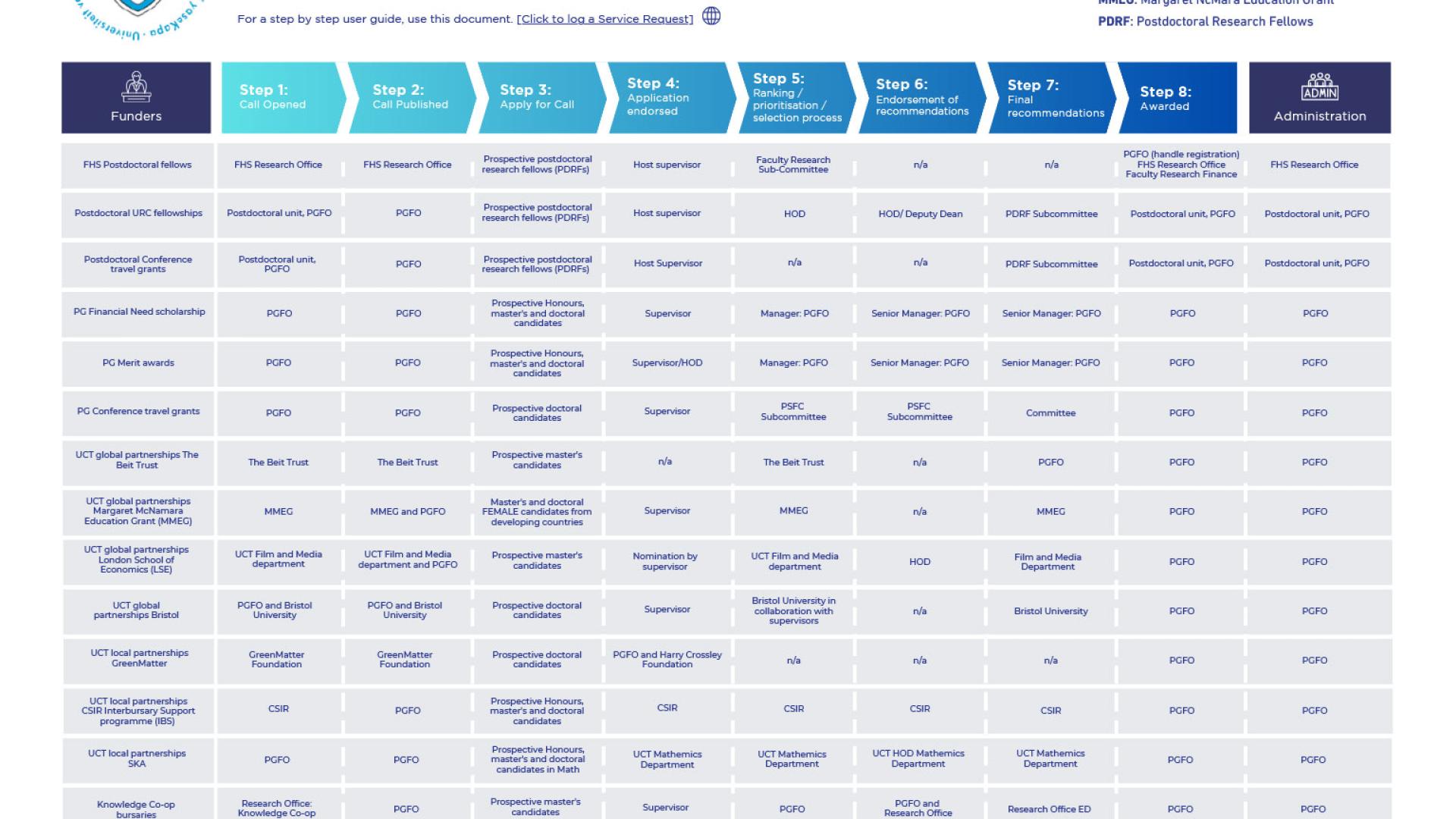
Responsibility matrixes
Download PDFs for a detailed overview of responsibilities: Centrally administered research funding opportunities | PGFO-administered internal research funding | Faculty of Health Sciences research-related funding



/ Step 1: Check and plan your application
Check your eligibility
Internal UCT funding opportunities are designated for specific purposes. Review the eligibility criteria set by the funding committee to determine if you qualify.
For assistance, contact:
- The designated contact person listed on the application form
- The FHS Research Intelligence team at the Faculty of Health Sciences (FHS) Research Office – FHS researchers only
- Research Support Services (RSS) for Research Office funding opportunities only
Plan your application
Applications for internal research funding require endorsement or recommendations from your head of department (HoD) and possibly a departmental/faculty representative. Plan ahead and inform your HoD of your intention to apply.
Follow up with the necessary parties to ensure timely endorsements, as late applications will not be accepted.
Closed
Identify and plan for these specific internal deadlines, as late applications will not be accepted. Typically, the following deadlines apply:
- Faculty deadline: Applications must reach the faculty for review by this date.
- Research Office deadline: Reviewed and endorsed applications need to reach the servicing officer by this date.
- Review deadline: The selection committee must finalise the list of recommended applicants by this date.
- Outcome deadline: Applicants must receive the outcome of their application by this date.
Closed
Carefully review the call opportunity and call-specific guidelines. Identify the elements required for your application. These will vary based on the funding source or administering faculty.
If the assessment criteria are available, review them to identify the key areas that are prioritised, allowing you to focus your application effectively.
Closed
/ Step 2: Source supporting documentation
In addition to endorsements, UCT may require supporting documents outlined in the funding call and call-specific guidelines. Obtaining these documents from individuals or entities can take time, so allow for this step in your timeline.
Commonly required information and supporting documentation may include:
- A proposal outlining the aims, objectives, research plan, budget, outcomes and impact of your research project
- A curriculum vitae (CV) or resume highlighting your qualifications and experience
- A publication record or list of previous research projects
- Letters of support or recommendations from collaborators
- Proof of existing or other funding sources
- Technical specifications and quotes for equipment or travel
- Acceptance of your abstract from conference organisers
- Confirmation from hosts for visits or training attendance
Note: CVs are essential for evaluating the qualifications of the principal investigator (PI) and key personnel involved in the project. They typically include educational background, positions held, research support, publications and any honours received. It is good practice for all staff to maintain current and easily accessible CVs for proposal preparation. The section "CV Activities" on the UCT electronic Research Administration (eRA) system can be used to create and update your CV.
/ Step 3: Initiate your application
Access the application form
To apply for internal research funding from UCT, you must complete an application form.
Note: Always access the form through the
The following applications are submitted via the UCT electronic Research Administration (eRA) system instead of using manual forms:
- Researcher development grant
- Conference travel
Complete the application form
Complete the application form for the internal funding opportunity, ensuring that all relevant sections are filled out. Where required, get the application endorsed by your HoD, supervisor or dean. If the assessment criteria are available, review them to identify the key areas that are prioritised, allowing you to focus your application effectively.
Note: Ineligible, incomplete or late applications will not be considered.
Attach supporting documentation
Gather the necessary supporting documentation and attach it to your manual application form or upload it via UCT eRA or ServiceNow. See list of commonly required supporting documentation for details.
External research funding
This section offers guidance on how to apply for external research funding, from national funding bodies and international funding bodies and who to contact within the university for assistance.
Proposal development and approval is not a linear process. The steps below provide an overview of key actions, but these often occur simultaneously. It is important to plan your proposal carefully, clearly defining tasks and roles. Also, ensure that the final proposal submitted to the funder has been approved by authorised UCT representatives.
Typically, applications to external funders by UCT researchers follow two distinct processes:
- Institutional approval: Obtain the necessary UCT approvals and log your application via the UCT electronic Research Administration (eRA) system.
- Funder application: Complete and submit your UCT eRA-approved proposal through a funder portal or on a funder-specific template, to be reviewed and assessed by the funder.
The steps below outline both these processes.
/ Step 1: Plan your proposal
Taking time to plan before drafting your proposal is essential. The steps outlined below provide guidance on key aspects to consider, helping you clarify your research objectives, anticipate challenges and align your project with the funder’s priorities, increasing your chances of success.
Check your eligibility
To apply for a funding opportunity, both UCT and you as the principal investigator (PI) need to be eligible. For assistance in interpreting eligibility requirements, contact:
- Faculty of Health Sciences (FHS) researchers – FHS Research Development
- Other researchers – International Grants Hub (IGH)
- National Research Foundation (NRF) – Research Support Services (RSS)
Plan your application
Before starting your proposal, understand the internal UCT approval process and deadlines, and review both the funder and UCT’s requirements, including budget specifics. Plan your timeline to accommodate both internal steps and funder expectations.
Check if approval via UCT’s electronic Research Administration (eRA) system is required. If approval is required, familiarise yourself with the process.
Closed
Identify, note and plan for internal UCT deadlines related to the business and technical components of your proposal. Adhering to these deadlines is crucial for receiving institutional approval for your proposal. They are set in relation to the funder’s deadline and allow for a thorough internal review, leaving enough time for you to make any necessary amendments.
Failure to adhere to the internal deadlines could result in your application not being submitted.
UCT deadlines are as follows:
- 12 weeks before funder deadline: submit proposal development support requests (if applicable)
- 6 weeks before funder deadline: alert budget reviewers of your intent to submit a proposal (required)
- 4 weeks before funder deadline: submit draft budgets to budget reviewers via UCT eRA (required)
- 5 working days before funder deadline: UCT eRA submission must reach the finance approver step (required)
Note: There are additional deadlines to consider if your proposal must also be approved by UCT Research Contracts and Innovation (RC&I). Typical proposals requiring RC&I submission include:
- National Institutes of Health (NIH)
- National Institutes of Health Research (NIHR)
- United Kingdom Research Institution (UKRI)
- SAMRC-SIR: South African Medical Research Council-Self-Initiated Research grants
- Wellcome
UCT deadlines for proposals that need to be approved and/or submitted by RC&I:
- 10 working days before funder deadline: UCT eRA submission must reach the finance approver step (required)
- 5 working days before funder deadline: submit proposal to RC&I (case-specific)
Note: If you are a sub-awardee, take note of the deadlines for submission as required by the lead institution, as these will differ from UCT’s internal deadlines and the funder deadline.
Closed
Note: To prevent delays, get access to the funder’s systems early in your proposal development timeline.
Read the call for funding and its specific guidelines carefully. Identify the technical and business elements that need to be submitted as part of your research proposal. Requirements will vary depending on the source of funding or the funder.
Funders also have general policies and guidelines that must be followed. Download, review, and adhere to these guidelines. Use the correct funder-specific templates and pay attention to funder notifications on any changes to proposal requirements.
Closed
Familiarise yourself with the budget requirements from both the funder and UCT:
- What is allowable in terms of the grant, e.g. for salaries, student support, travel, equipment?
- Does the funder require a breakdown per cost category?
- Does the funder have a specific budget template that must be used?
- Have you included the maximum allowable indirect costs?
Note: A common mistake is that researchers do not include the maximum allowable indirect costs – avoid this pitfall!
Closed
Indicate your intention to submit
If you haven’t already, complete the Intention to Submit form as soon as you decide to apply for a funding call. High-quality proposals need planning, coordination, and teamwork, often under tight deadlines. Submitting the form, ideally at least twelve weeks before the funder’s deadline, ensures you receive the maximum level of research support.
Alert your budget reviewer
Your budget reviewer is a staff member in your faculty finance team who assists you with budget development. Alerting your budget reviewer of your intention to develop a proposal for a funding call will allow them to plan their workload and carve out time to assist you.
Note: Your budget reviewer must be alerted six weeks before the funder's deadline.
Here is the list of budget reviewers per faculty you can contact.
Key research proposal requirements: Resources, ethics, compliance and outputs
As you plan, consider that these aspects could affect your proposal and may require additional documentation.
Each project must have an identified principal investigator (PI) who takes primary responsibility for the contract, fund management, and grant reporting. The PI must be a registered UCT staff member. Postdoctoral research fellows cannot serve as PIs. Projects can also include co-principal investigators who share equal responsibility and leadership with the PI, as well as co-investigators who contribute materially to the research project outcomes.
UCT’s electronic Research Administration (eRA) system requires you to identify a PI as the administrative lead from UCT and allows you to tag additional co-investigators or co-principal investigators as needed.
Closed
The resources needed for your research project can range from a single PI to a multidisciplinary team with administrative support. Assess your staffing needs early and thoroughly to budget accurately for their time, identify the required skill sets and allow enough time to secure the required resources.
Note: Consult the call document for any restrictions before budgeting for staff on your research project.
Closed
Adequate research infrastructure is crucial for conducting high-quality and impactful research. Consider what infrastructure you need, how long you will require it for, and whether you have access to it or need to purchase/rent it and include these costs in your proposal budget.
Infrastructure can include:
- Lab space
- Office space
- Storage or sample storage
- Research equipment
- Computational IT/infrastructure
This information is logged via UCT eRA on the tab “Resourcing, ethics, and biosafety”.
Closed
The world of research has changed and with the rise of big data and artificial intelligence, your research project will now rely more than ever on information and communication technology (ICT) for functions such as:
- Data management
- Computing and high-performance computing
- Software
- Hardware
- Storage and backup
- Collaboration and communication
- Data dissemination and publishing
- Cybersecurity and privacy
This landscape can be overwhelming and difficult to navigate, but various UCT support services are available to assist you in interpreting your requirements and accessing the required resources.
At the proposal development stage you need to consider your ICT and eResearch needs to ensure they are accurately costed and included in your budget. For assistance, visit the UCT eResearch website and log an eResearch request via the UCT ServiceNow portal.
UCT eResearch is a partnership between UCT ICTS, UCT Libraries and the Research Office and they will connect you to the appropriate support services throughout the research project lifecycle. For contact details, see UCT eResearch.
Closed
A Data Management Plan (DMP) is a document that outlines how you will manage, store and organise your research data throughout your project and after it is completed. It helps ensure your data is well-documented, accessible and preserved for future use. A DMP is a living document that should evolve as your project progresses.
Many funding bodies and publishers encourage or even mandate the submission of a DMP and at UCT it is a requirement for all researchers and postgraduate students to submit a DMP as part of their research process.
A solid DMP addresses key areas like the below, helping you manage your data efficiently and in compliance with regulations:
- Data collection
- Storage
- Ethics
- Security
- Sharing
- Long-term preservation
A DMP will need to be prepared and submitted as part of your research proposal. Check whether your funder has a specific DMP template or requirements for submission.
UCT Digital Library Services (DLS) provide:
- Assistance and training in developing a DMP: Watch the webinar Creating a Data Management Plan with UCT DMP (2024), part of the UCT DLS Digital Scholar Series.
- Guidelines on specific funder DMP requirements, see Funder guidelines (UCT DLS) and Overview of funders’ data policies of the Digital Curation Centre.
For assistance, email Digital Library Services.
Closed
UCT requires prior ethics review and approval for all research involving human participants and/or their data or biological samples, according to faculty guidelines, before commencement of any research activity.
You don't need full ethical approval before submitting your proposal, but you must determine if your project requires ethical approval and at what level. You should also have started the approval process.
See also our Ethics page for more information.
Closed
A clinical trial is a research study that assigns human participants or groups to one or more health-related interventions to evaluate their effects on health outcomes and assess safety and efficacy.
All clinical research must follow the SA Good Clinical Practice (GCP) Guidelines and obtain approval from the UCT Human Research Ethics Committee (HREC). Be sure to budget for clinical staff such as medical doctors, nurses or pharmacists to conduct the research. If the study involves an intervention, such as drug, device, supplement or counselling, it requires approval from the South African Health Products Regulatory Authority (SAHPRA), so plan accordingly.
Additionally, plan for follow-up visits, including safety blood tests, where applicable, to monitor participant safety, even if it is not your primary outcome.
For assistance with clinical trials, engage with the UCT Clinical Research Centre, which has a research ward, pharmacy and processing laboratory that comply with regulatory requirements.
Closed
UCT requires prior review and approval by an animal ethics committee for any research involving animals by any UCT researcher, including those publishing under UCT’s name and for any other person conducting animal research at UCT.
For information on the animal ethics of individual faculties, see these links:
- Faculty of Health Sciences: Animal Research Ethics
- Faculty of Science: Animal Ethics
Closed
UCT is committed to the safe handling and containment of potentially hazardous biological agents to prevent harm to human health and the environment.
Laboratory-based research using human biological materials such as tissues, blood, bodily fluids and research using potentially hazardous biological agents requires approval from your Faculty Biosafety Committee and, if referred, by the Institutional Biosafety Ethics Committee.
Assess potential biosafety risks associated with your project and consult the relevant biosafety guidelines. Develop a comprehensive biosafety plan that outlines your safety measures and protocols. Document all biosafety considerations clearly in your proposal and engage with your faculty biosafety committee as required.
For further details see our Biosafety page.
Closed
Under a sub-award, the primary recipient transfers its responsibility to perform part of the project to another party. Two types of sub-awards exist:
- Outgoing sub-award: UCT is the primary applicant and there are other institutions/parties who we work with.
- Incoming sub-award: UCT is the sub-awardee, and a primary applicant has transferred part of the project to us.
Outgoing sub-award
Send UCT’s sub-award commitment form to the sub-awardee for completion. Be mindful of the funder-specific requirements for sub-awardees, as it is your responsibility as the primary applicant to secure all necessary documentation.
UCT has developed a standard sub-award commitment form that includes the information typically requested from sub-awardees in outgoing sub-awards. In addition to this, there is a standard sub-awardee commitment letter template, to be used in addition to the formal sub-award documentation, to confirm a collaborating institution’s intent and key commitments at proposal stage.
Sub-Award Commitment Form Sub-Award Commitment Letter (Template)
Note: Work with Research Contracts & Innovation (RC&I) and the relevant International Grants Hub (IGH) or FHS Research Development at the Faculty of Health Sciences (FHS) to confirm and refine the specific requirements for your project and funder. Request this information upfront to ensure your application is submitted on time, and give the sub-awardee sufficient time to gather the required details.
Incoming sub-award
The primary/submitting institution may require an approved document, referred to as a sub-recipient commitment form, FacePage, authorised representative commitment or statement of intent. Inquire about this document upfront with the primary/submitting institution to understand the required information.
For assistance with such document contact:
- International Grants Hub (IGH)
- Faculty of Health Sciences (FHS) researchers: FHS Research Development
This document is part of the UCT’s electronic Research Administration (eRA) pre-awards approval process and needs to be signed by UCT's Research Contracts & Innovation (RC&I) before being uploaded.
Closed
A conflict of interest arises when your private interests, such as financial or personal relationships, could interfere with your professional responsibilities or decision-making in your research.
You are required to:
- Declare any potential conflicts before starting a research project or applying for funding
- Complete necessary training on conflicts of interest and retain supporting documentation
- Familiarise yourself with UCT’s policy and procedures Conflicts of Interest: Principles, Policy and Rules to ensure integrity and objectivity in your work
More information on the topic can be found on our page Conflicts of interest. For assistance, email the Office of Research Integrity (ORI).
Closed
You may be required to complete some form of due diligence (DD) as part of your proposal application. This could range from completing and signing a form to submitting an array of documents such as
- UCT policies
- Audit reports and financial records
- Proof of collaborations
- Corporate governance documents
The International Grants Hub (IGH) can help you interpret the due diligence requirements.
Closed
Many funders require a plan or strategy for how you will manage intellectual property (IP) or knowledge assets that may arise from your research. This plan should be considered during the proposal development stage and should include details on:
- Protecting results
- Ownership and access rights
- Confidentiality measures
- Commercialisation routes
At UCT, IP is governed by the university’s Intellectual Property Policy. UCT's Research Contracts & Innovation (RC&I) can assist you in developing research results into new processes, services, or products, and in setting up spin-off companies if required. Email RC&I or visit their Intellectual Property page to learn more.
Closed
/ Step 2: Develop your proposal
Once you've planned your proposal, start developing it. The points below guide you on preparing your narrative and budget, who to contact for assistance, what supporting documentation you need and how to obtain it.
Funder-specific content
Funders often provide guidance on how to complete your application either in the specific call for funding or associated call guidelines or in their general funder guidelines. In some instances, they will provide a template or a specific format. If available, read the funder’s assessment criteria, included in the call for funding or call guidelines, to identify areas of the application that are most highly weighted or considered and should therefore be the priority focus.



Standard elements of your proposal
Proposals usually consist of a minimum of four main components, which are described in detail below:
- Proposal narrative
- Budget and budget justification
- Supporting documentation
Note: You can only submit your proposal and budget to the funder after receiving full internal approval as part of the pre-award approval process which is usually via the UCT electronic Research Administration (eRA) system. Take note of Proposals exempt from UCT eRA approval.
Proposal narrative
The proposal narrative describes the research to be conducted and may include a timeline, milestones, aims and objectives, background, methods, expected outcomes and key deliverables. Consult the call for funding and call-specific guidelines for guidance. The level of detail will vary depending on the type of proposal/award and funder, and should be adjusted accordingly.
Budget
A budget is a detailed statement outlining estimated project costs that support a funded research project. All research projects at UCT must be fully costed and budgeted, considering both direct project costs and indirect support costs when preparing budget proposals and finalising contracts. Budgets should include all direct costs, staff costs and other administrative costs required to carry out the project’s objectives, as detailed in the proposal narrative.
Note: Your draft budget must be submitted to your budget reviewer four weeks before the submission deadline.
Your budget will be reviewed and approved as part of the pre-award approval process. In most cases this is via UCT’s Electronic Research Administration (eRA) system.
If the funder allows for it, indirect costs at the full amount permitted must be included in your budget. Your budget reviewer will complete a UCT costing template, which calculates how far the indirect costs allowable by the funder will go towards meeting the full costs associated with hosting and providing research support for your project. This will indicate the extent to which UCT will need to cross-subsidise your research.
Indirect cost recovery involves recouping expenses for essential support services that are not directly linked to a specific research project but are necessary for its overall support. This is detailed in UCT’s Policy for Costing and Pricing of Research and Research-Related Contracts.
The requirements, format and detail of budgets depend on the funder. Follow the budget format outlined in the funding call and call-specific guidelines, and adhere to UCT’s costing principles when preparing your budget.
Contact your budget reviewer for assistance in developing your budget. They will be able to offer guidance on exchange rates, inflation, value-added tax (VAT), cost categories and the inclusion of indirect costs.
Budget justification
Budget justifications, also known as budget narratives or budget details, are crucial for both the internal and external review process. They specify how the funder’s money will be spent. Justify budget costs in detail according to the funder’s instructions and explain any estimates or unusual circumstances. Retain supporting documentation, rationales and sources for estimates, as well as vendor catalogues or written quotes as supporting evidence.
Supporting documentation
Funders often require documentation to verify the feasibility, qualifications and compliance of your proposed research proposal.
Supporting documentation can include letters of support, CVs and other funder-required documentation.
Funders may have specific requirements for support letters outlined in the funding call and call-specific guidelines. Remember that obtaining these letters from individuals or entities can take time, so allow for this step in your timeline.
Note: Support letters in most cases must be requested three weeks before the funder deadline and will only be provided once your proposal and budget have been approved via UCT’s electronic Research Administration (eRA) system.
Common letters of support requested by funders act as proof of:
- Institutional support: support from the lead institution, endorsing the proposed research project or from a co-applicant institution, endorsing their researchers’ participation in the project
- Faculty support: the faculty dean or deputy dean of research endorses the proposed research project
- Departmental support: an academic department agreement to host the proposed research project, usually from the head of the department (HoD)
- Collaborators’ support: confirmation that an individual or organisation agrees to participate in the proposed research project
Institutional letters of support
Institutional letters of support are usually signed by UCT's Vice Chancellor or Deputy Vice Chancellor of Research, or by a delegated legal authority within UCT such as the director of UCT's Research Contracts & Innovation (RC&I), the executive director of research, or the Registrar.
Faculty of Health Sciences (FHS) researchers can request an institutional letter of support by completing the form below.
FHS Institutional Letter of Support Request Form
If you have questions around letters of support, email
- FHS Research Development – Faculty of Health Sciences (FHS) researchers
- International Grants Hub (IGH) – other researchers
Closed
Faculty support letters are usually signed by the dean or deputy dean of your faculty.
Faculty of Health Sciences (FHS) researchers can request an institutional letter of support by completing the form below.
Closed
A departmental letter of support is usually signed by your head of department (HoD). Email your HoD directly to request one.
Closed
For a collaborator support letter, liaise with your collaborator directly.
Closed
Most funders use CVs to assess the qualifications of the PI and key personnel involved in the research project. Include relevant details on:
- Education and training
- Positions held
- Research support
- Publications
- Relevant honours or other recognition received
Note: Keep your CV up to date and easily accessible for proposal preparation. Use the section “CV Activities” on UCT eRA to prepare and maintain your CV.
Funders generally have CV requirements. For example, NIH applicants can use SciENcv: Science Experts Network Curriculum Vitae to ensure their bios conform to NIH requirements. Some UK-based funders require you to tailor your CV to make it relevant to the specific application by including a narrative around your contribution(s) to your research field.
Your existing CV may not be appropriate for your funder’s requirements, so please read the call-specific guidelines upfront and tailor your CV accordingly.
For guidance with CVs, email the International Grants Hub (IGH). Faculty of Health Sciences (FHS) researchers can email FHS Research Development.
Closed
Proposal development support
Limited support and guidance is available for proposal development, subject to availability. Requests will be evaluated and prioritised on a case-by-case basis.
To request proposal development support email:
- FHS Research Development – Faculty of Health Sciences (FHS) researchers
- International Grants Hub (IGH) – other researchers
/ Step 3: Obtain UCT approval
Proposals and their associated budgets must be approved internally by UCT before being sent to the funder. This process is typically done via UCT’s eRA system, though alternative procedures apply for certain funding sources that do not use UCT eRA.
UCT eRA approvals are split between application-stage approval and contract-stage approval. The application stage-approval form is completed when you are applying for research funding.
Review this process guide on securing pre-award approval via UCT eRA.
Proposals exempt from UCT eRA approval
Initiate the UCT eRA approval process
Log on to UCT eRA using your researcher role to initiate an application stage approval.
As the principal investigator (PI), you are responsible for completing the tabs “Key information” and “Resourcing, ethics and biosafety”. All fields marked with an asterisk (*) are mandatory.
For assistance with the UCT eRA approval process contact:
- Faculty of Health Sciences (FHS) researchers – FHS Research Development
- Other researchers – International Grants Hub (IGH)
Progress your application through the UCT eRA process flow
Your budget reviewer enters the budget information via UCT eRA on the tab "Financial Information".
If further information is required from you to complete your budget you will be notified via email. You can also monitor the status of your application via UCT eRA.
If further information is needed, the status will show as "Returned to applicant for clarification/action." Use the feedback from your budget reviewer to make changes and resubmit the updated budget via UCT eRA.
Once the Financial Information tab is complete, the application is returned to you for review. As the PI, you are responsible for managing the project and budget. If you spot any errors in the Financial Information tab or budget, return it to the budget reviewer for correction by selecting "Submitted to budget reviewer." If your budget is complete and accurate and the application meets all funder requirements, click the checkbox for “Final declaration by principal investigator”.
If you need to provide additional information, enter a comment in the text box. Once satisfied, click "Save and close" and move the application forward by selecting "Submitted to finance approver." Your application is then sent for faculty approval.
Note: Ensure all information is correct before submission. Making changes after the workflow reaches faculty approval via UCT eRA will require you to repeat all prior internal approval steps.

Monitor the status of your application via UCT eRA
The last two steps of the UCT eRA internal approval process require no further input from you. They are included here only for your awareness, to provide a complete overview of the process.
- Finance approval: The finance approver, either the research finance accountant or your faculty finance manager, reviews the application’s accuracy and completes the necessary sections under the tab Approval by Finance Approver. They assign final faculty approvers and either move the process forward by selecting “Submitted to dean/deputy dean/final faculty approver” or returning the application to the budget reviewer for further action.
- Final approval: The final faculty approver, usually the dean or deputy dean of research of your faculty, reviews the application for accuracy. In the Faculty of Health Sciences, this role is delegated to the Research Development team (research development manager or proposal development project manager). If further clarification is required, they return the application to the budget reviewer. If institutional approval is necessary, the application will be marked as “RC&I review” and will go through RC&I for final approval.
Once all the necessary approvals are in place, the application is marked as “Institutional approval – ready for submission by the institution/PI”.
Note: Your application is not submitted to the funder via the UCT eRA system.
/ Step 4: Complete your application in the funder-required format
The steps below outline the process for developing your proposal, which will be sent to the funder for assessment and funding decisions. The proposal submitted to funders must include the same details as the application logged via UCT eRA and the budget approved by UCT Finance.
Funders typically require applications on their specific templates, either online through their funding portals or as manual forms for email submission. Always check each funder’s requirements, follow the call-specific guidelines, and ensure all required fields are complete.
For online submissions, register on the funder’s portal and complete the application there.
Complete the budget section developed in consultation with your budget reviewer
When completing the budget section of the application, ensure the figures match those approved through UCT.
Upload supporting documentation
Upload all required supporting documentation to the application. This could include:
- Curriculum vitaes (CVs) for PIs and key personnel
- Budget and budget justification
- Institutional approval letters
- Data management plan (DMP)
- Research protocols
- Letters of support
- Ethics and biosafety documents
Your application is ready to go to the next stage once you have:
- Logged an application stage-approval via UCT eRA.
- Completed and finalised as per the funder specifications with all supporting documentation attached.









Useful links
UCT researchers seeking to develop their proposal and have it approved, may find these links helpful:
- UCT Policies > Research: Browse all research-related UCT policies.
- Research support at UCT: Browse our infographics and responsibility matrixes for research support units at UCT.